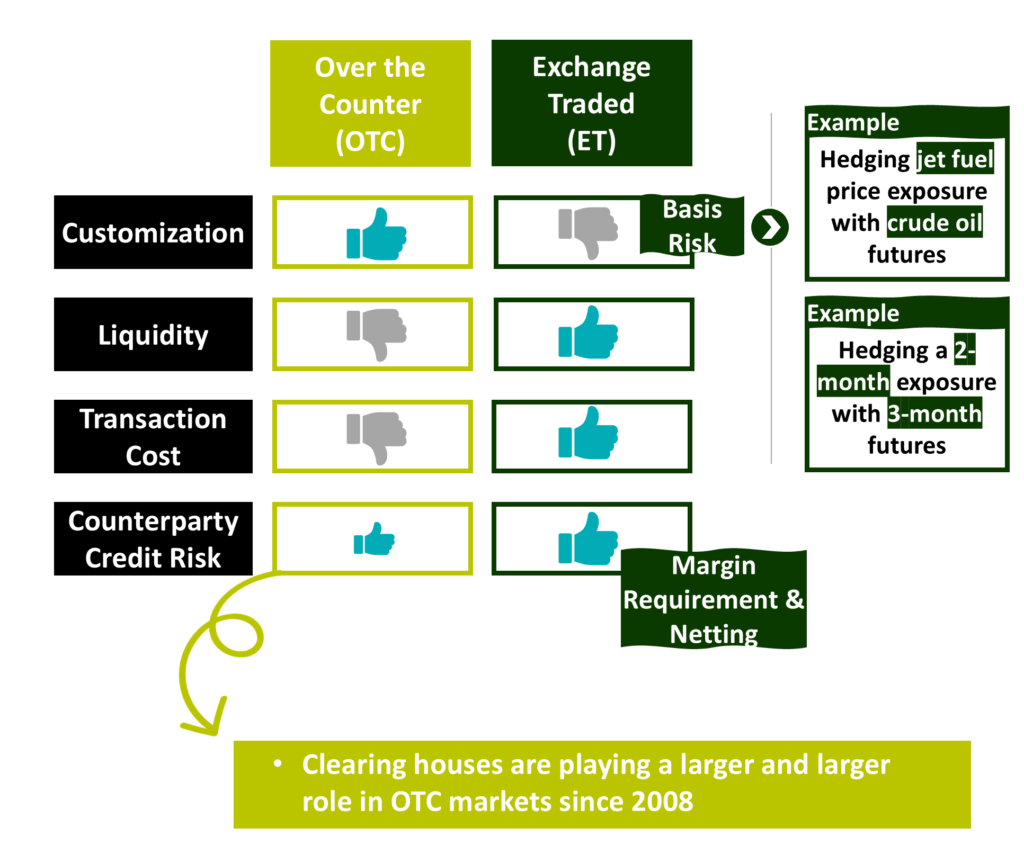
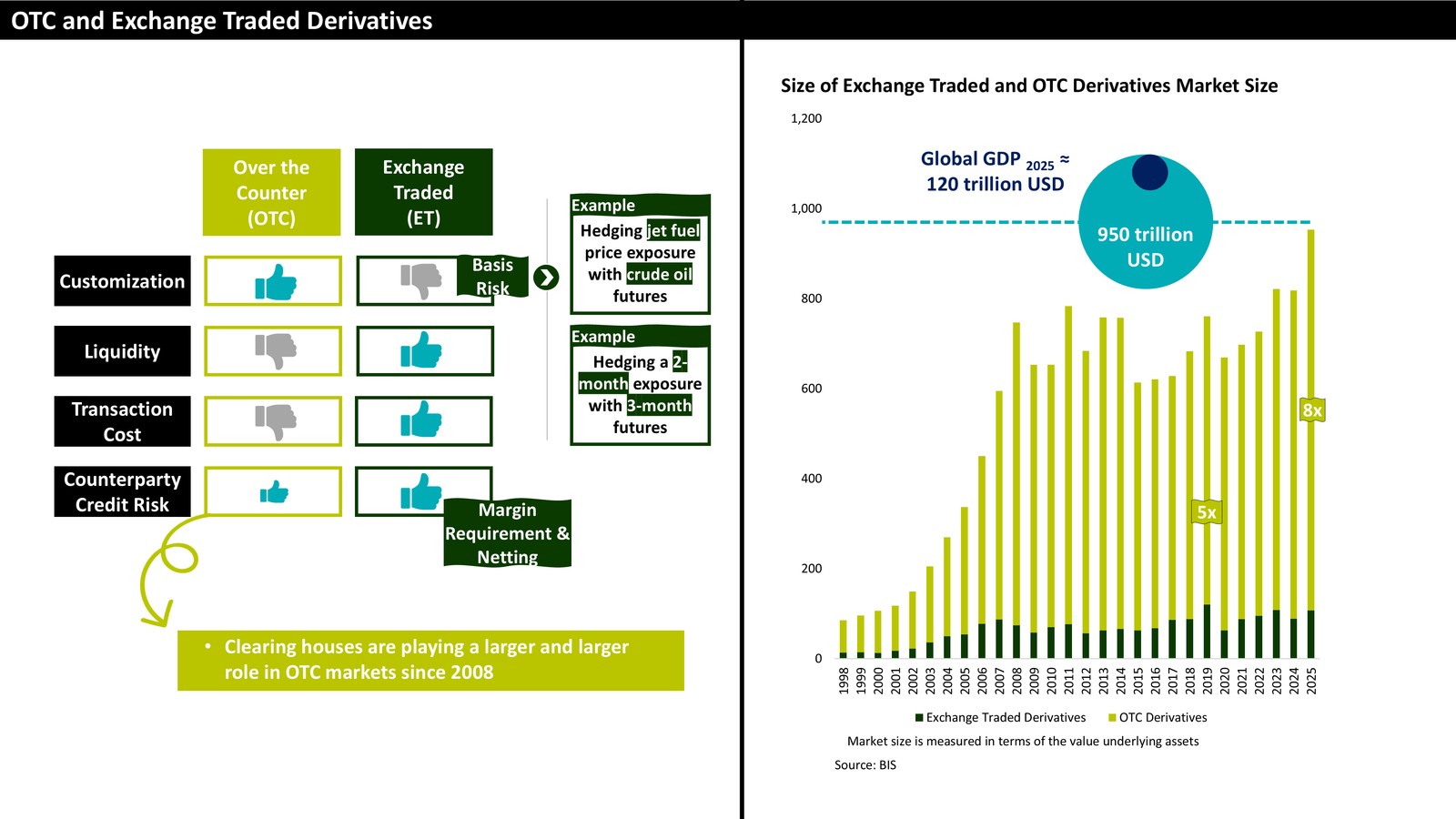
Over-the-counter (OTC) and exchange-traded derivatives differ mainly in terms of customization, liquidity, transaction costs, and counterparty credit risk. OTC derivatives offer greater customization, while exchange-traded derivatives are standardized.
This standardization can create basis risk, for example when a jet fuel exposure is hedged with crude oil futures, or when a two-month exposure is hedged with a three-month futures contract because a perfectly matching contract is unavailable.
Exchange-traded derivatives generally have the advantage in terms of liquidity and transaction costs, as they are traded on organized exchanges.
Exchange-traded derivatives also tend to involve lower counterparty credit risk because of margin requirements and ongoing netting. However, since the 2008 financial crisis, clearinghouses have played an increasingly important role in OTC markets as well, reducing this disadvantage.
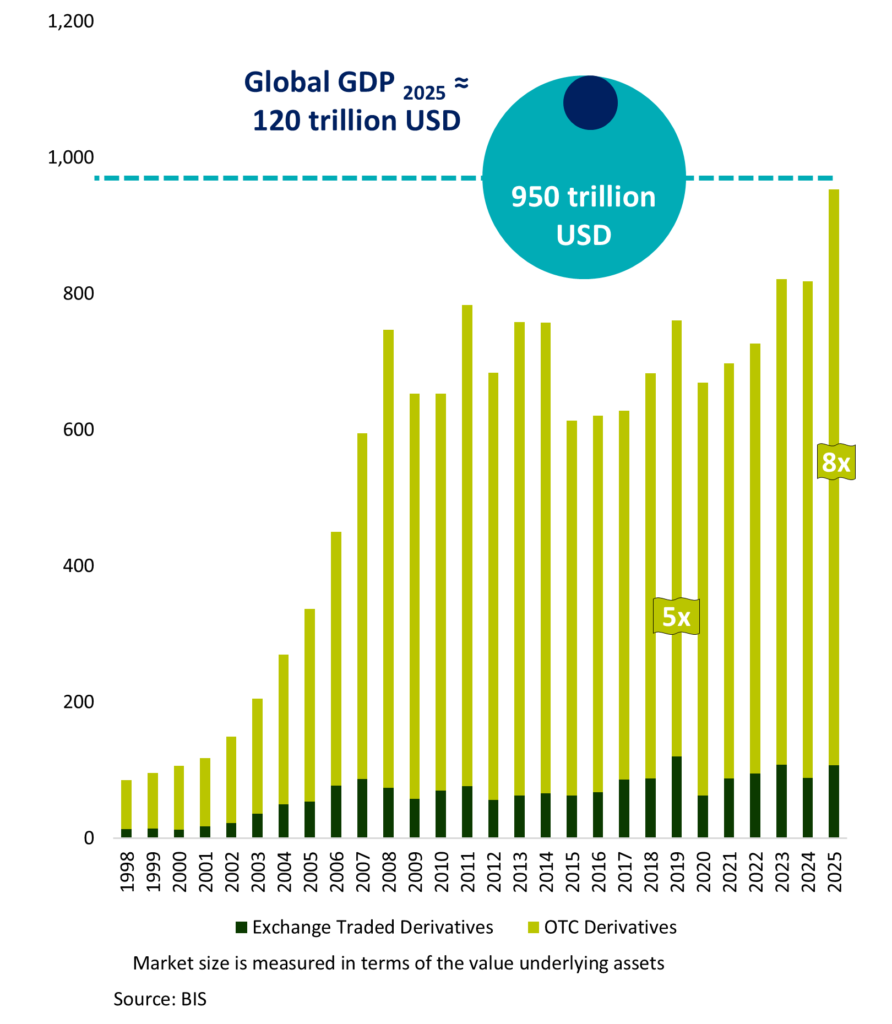
OTC & Exchange Traded Derivatives Market Size
The OTC derivatives market is significantly larger than the exchange-traded market.
In 2019, the OTC market was about five times larger, while by 2025 the difference was around eight times.
The total derivatives market is close to USD 950 trillion, which is particularly striking when compared with global GDP of roughly USD 120 trillion in 2025.