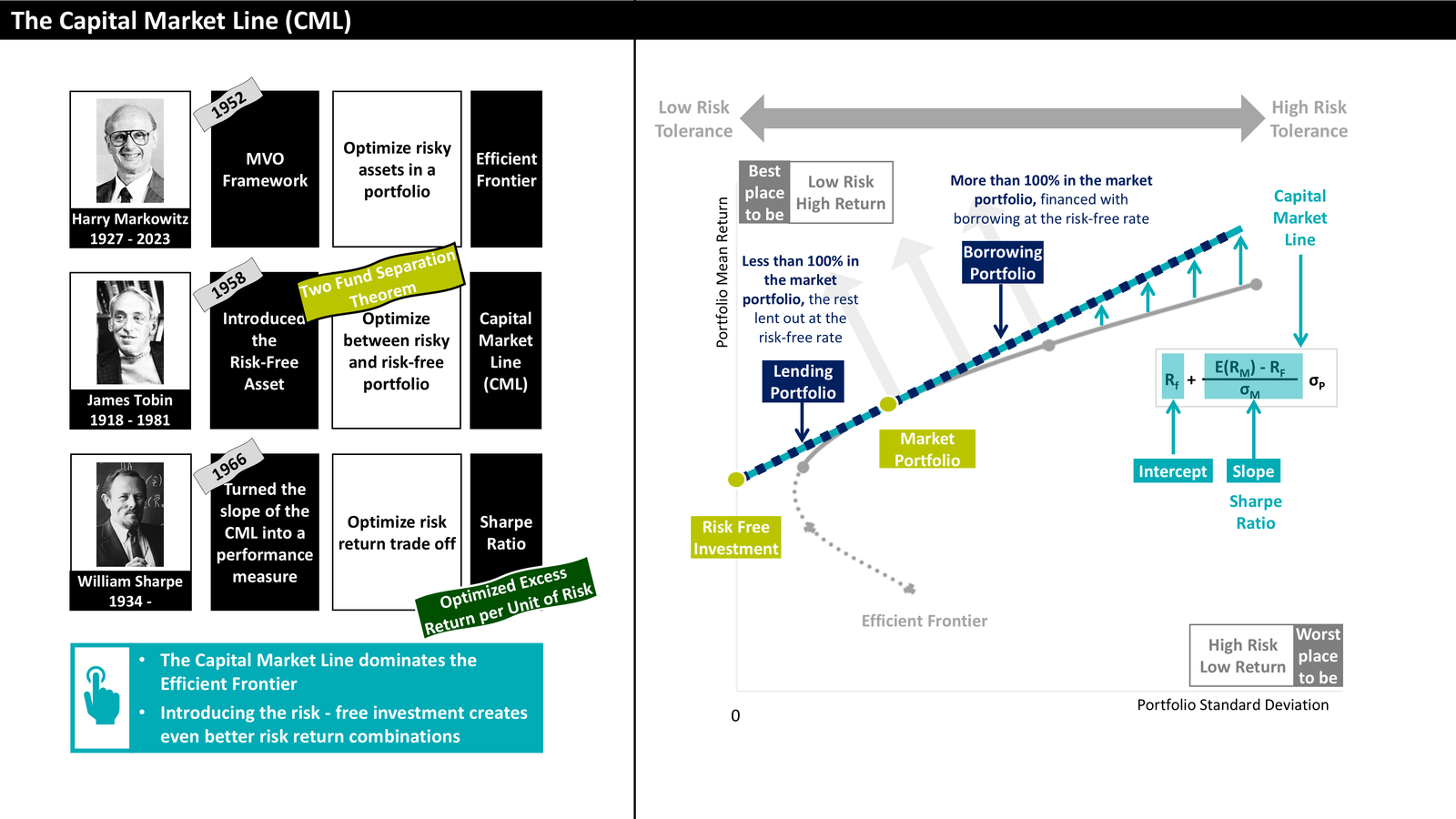
From Markowitz to Tobin and Sharpe | The evolution of the Capital Market Line
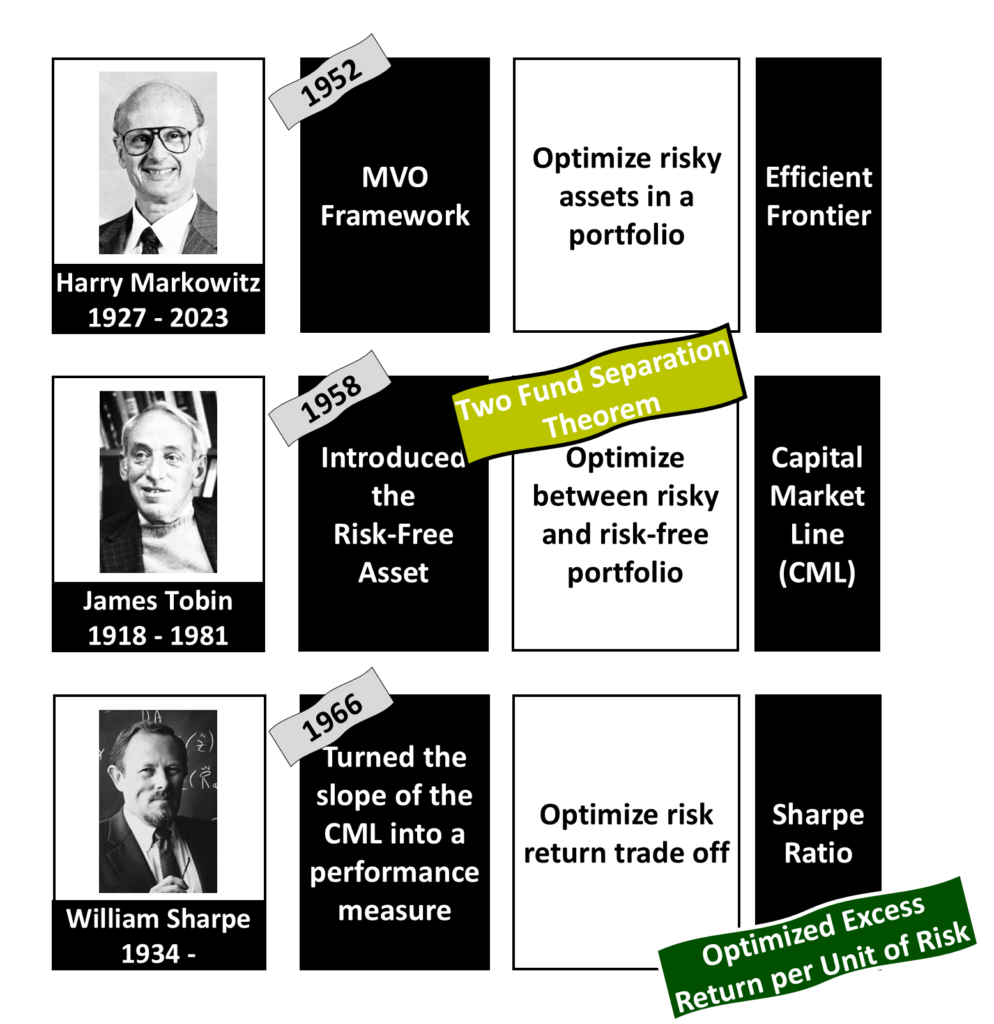
The Capital Market Line (CML) emerged from three major contributions to modern portfolio theory:
- Harry Markowitz (1952) — Efficient Frontier
Introduced Mean–Variance Optimization (MVO), identifying portfolios that maximize expected return for a given level of risk. - James Tobin (1958) — Two-Fund Separation
Introduced the risk-free asset into portfolio selection, allowing investors to combine it with an optimal risky portfolio. Under CAPM assumptions, this leads to the Capital Market Line (CML). - William Sharpe (1966) — Sharpe Ratio
Developed the Sharpe Ratio, measuring excess return per unit of volatility. The slope of the CML represents the market portfolio’s expected Sharpe Ratio.
Key FRM Part 1 Takeaway
Markowitz established the Efficient Frontier, Tobin demonstrated the benefits of introducing a risk-free asset, and Sharpe developed a measure of risk-adjusted performance.Capital Market Line (CML) and the Efficient Frontier
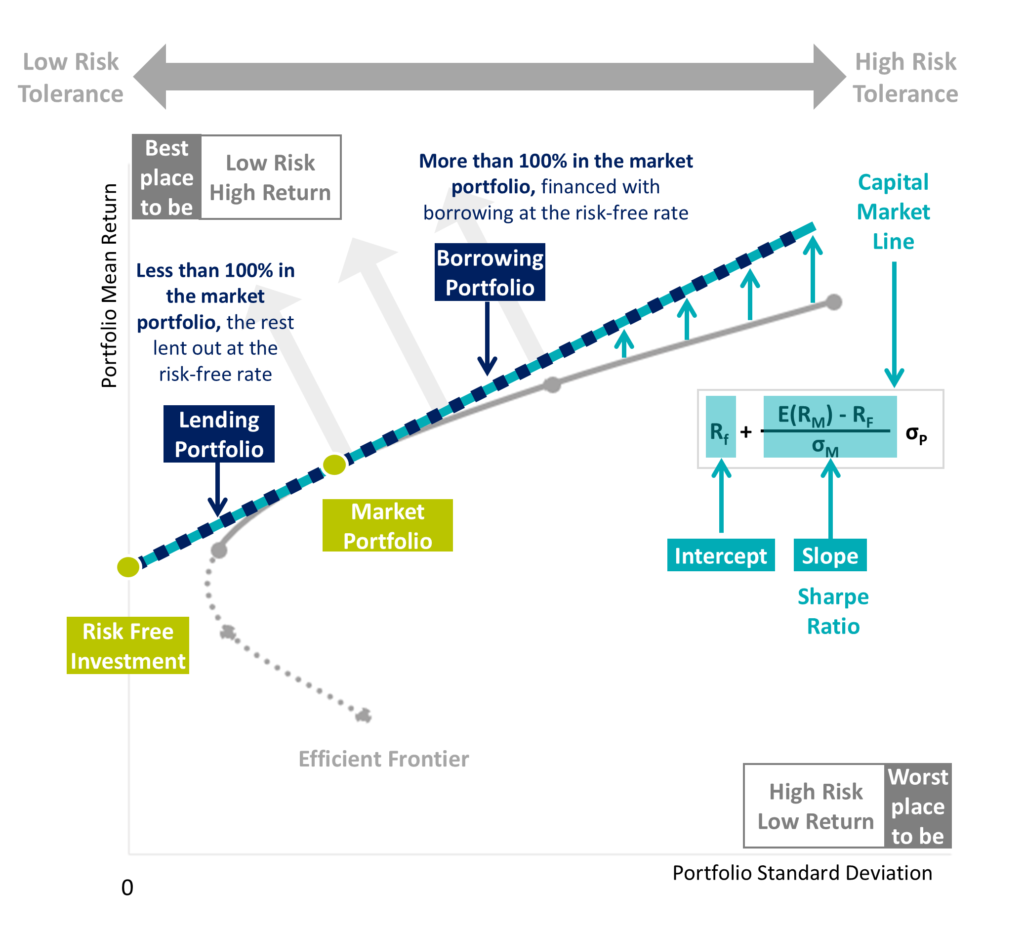
The Capital Market Line (CML) connects the risk-free asset with the market portfolio, offering superior risk–return combinations compared with the risky-asset Efficient Frontier under standard CAPM assumptions.
- Lending Portfolio: Risk-averse investors allocate less than 100% to the market portfolio, investing the remainder at the risk-free rate.
- Borrowing Portfolio: More risk-tolerant investors borrow at the risk-free rate to invest more than 100% in the market portfolio.
Sharpe Ratio and the CML
The intercept represents the risk-free rate, while the slope represents the market portfolio’s expected Sharpe Ratio.
Key FRM Part 1 Takeaway
Introducing a risk-free asset enables investors to achieve better risk–return combinations, with the CML dominating the risky-asset Efficient Frontier except at the tangency point.
Author: Braia Renata, FRM, CFA, CPA | Creator of Prepvisuals